Showing posts with label 1970s. Show all posts

Friday, March 2, 2018

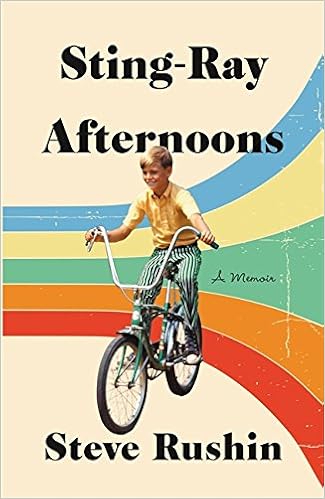
Sting-Ray Afternoons by Steve Rushin

Image result for sting ray afternoons

Title: Sting-Ray Afternoons
Author: Steve Rushin
Genre: Memoir, 1970s

The author is well known for his work for Sports Illustrated, and his humorous recollections of growing up in the 1970s is entertaining reading. Rushin grew up in the Midwest (first Chicago and then Minneapolis), and he is able to effectively convey his reminisces so that they resonate with anyone who was raised during that period in any part of the country. Nerf footballs, Fonzie, Pete Maravich, Evel Knievel, Red Owl grocery stores, vacations at the Wisconsin Dells, and of course the Schwinn Sting-Ray bicycle with the banana seat are only a few of the many symbols of the 70's that are covered.

Along the way, Rushin also describes - in amusing fashion - his Catholic upbringing as a middle child with four siblings. His stories about his middle class family with a salesman father and stay-at-home mother ring true for many who remember the era. Rushin's generational memoir is an enjoyable read that will take many back to a more innocent and less complicated time.

- Mike

Check out Sting-Ray Afternoons @ the library.

Friday, August 8, 2014

Let the Great World Spin by Colum McCann


On August 7, 1974, a tightrope walker, Philippe Petit, walked across a high wire rigged between the newly-built Twin Towers of the World Trade Center, 1350 feet above the ground. The stunt was unauthorized and a surprise to all who saw it.  In Let the Great World Spin, Colum McCann uses this event to unite the stories of various New Yorkers: prostitutes and the Irish priest who ministers to them; the priest’s brother who works as a bartender; a group of mothers who have lost sons in the Vietnam War; a judge and his wife; an immigrant nurse; two artists visiting from upstate and various other New Yorkers whose lives intersect in surprising ways. This is a character driven novel. More than ten different voices tell the story of strangers drawn together by a trial, an automobile accident, and a death. Lurking in the background are the defining anxieties of the early 1970’s: the Vietnam War and the resignation of President Nixon. Petit kept his balance while walking between the towers. The same could not be said of some who watched him from New York’s streets. Lives fell apart. People died. “NOBODY FALLS HALFWAY,” read a sign Petit kept on his wall.  This was as true of the ordinary people in the book as of the acrobat. And those who kept their balance throughout life put their own sorrows aside and stepped up to help friends and strangers deal with theirs. A book that celebrates the generosity of the human spirit, Let the Great World Spin a heartfelt look at a city and its citizens.

Friday, July 25, 2014

A Fine Balance by Rohinton Mistry


In the 1970’s India suffered through a period of social upheaval and political oppression. Prime Minister Indira Ghandi imposed a State of Emergency on the country. She did this mainly to retain political power (ruthlessly purging and arresting opponents and other government officials.) She also tried to forcibly modernize the country. Her thugs, enforcing her policies, inflicted misery on the poorest citizens. Often they were forcibly rounded up and bussed to political rallies to increase crowd size. Men were kidnapped off the streets and subjected to involuntary vasectomies in appalling conditions. People were left homeless and even killed in a careless, poorly-planned effort to eradicate slums.  This is the society in which the four protagonists of A Fine Balance by Rohinton Mistry, struggle to survive.
Dina, a widow resisting remarriage, tries to retain her independence and her own home by starting a dress-making business. To this end, she hires two itinerant tailors, Ishvar and his nephew Om.  They belong to the Untouchable caste and are fleeing violence in their own state. Dina also takes a boarder, Maleck, a young student from the north of the country. At first the arrangement works for all involved. Ishvar and Om are happy to have work; Maleck is pleased to have a place to live. And Dina is thrilled to have established a successful business that enables her to maintain her independence.  But their little haven of tranquility is soon disrupted when corrupt and powerful politics interfere with their daily lives. Eventually Maleck, unable to coexist with the pervasive violence in Indian life, leaves the country. But Dina, Ishvar and Om cannot leave. They must learn to accept the harsh circumstances of their lives. Despite their suffering, including hunger, homelessness, illness, and eventually, forced sterilization, the two tailors retain a heart-breaking acceptance of whatever hardships they must endure.  And Dina never allows disappointment destroy her sense of decency. They have found the fine balance needed to survive in Indira Ghandi’s India.

Tuesday, January 7, 2014

Perfect by Racehel Joyce


In 1972, in suburban England, two smart and observant English boys, Byron and James, are somewhat obsessive about perfection. They want things to be right and earnestly try to correct anything that is amiss. But, although they are smart and observant and well-meaning, they are eleven year old children. They do not always understand what they have observed, particularly the dynamics of adult relationships. Consequently, their meddling creates unintended problems, particularly for Byron’s kind mother, Diane, who must strive every moment of her life to conform to the expectations of her exacting and controlling husband. When Diane inadvertently becomes involved with a working class family in the area, the boys perceive each minor mishap as a catastrophe. Their well-meaning meddling creates chaos that consumes Diane’s life. In an alternate story occurring in present day England, a middle-aged man, Jim, struggles to adapt to independence after the mental hospital in which he has spent his entire adult life is closed. Unlike other patients, Jim has no family to go to and must learn to cope on his own. When some co-workers at his new job befriend him, he finds himself with an unorthodox support group that helps him navigate the complexities of everyday life. The two stories eventually connect in the surprising conclusion of Perfect. Rachel Joyce is the author of The Unlikely Pilgrimage of Harold Fry, and in Perfect she has created another quirky, character-driven novel.

Check out Perfect @ the library!

Tuesday, December 31, 2013

After Visiting Friends by Michael Hainey

In 1970, Chicago newspaperman Robert Hainey died suddenly in the early hours of the morning. He was thirty-five and left behind a wife and two young sons, one of whom was Michael Hainey, then six years old.  Michael’s mother, Barbara, never discussed the death with her sons and curtly cut off all questions. This only heightened Michael’s need to know. When he was older, he found his father’s obituaries in library archives. He read that his father died on a Chicago street far from both his home and his workplace. The phrase “after visiting friends” was used, although the family had no friends in that area of Chicago. The desire to know the facts remained with Michael into adulthood. He became a journalist and eventually used his training to investigate the circumstances of his father’s death. His father’s co-workers claimed to be unable to tell him anything. But that was an answer he was unwilling to accept. He worked for years, searching out old medical records and finding long-ago acquaintances of his father’s until he arrived at the difficult truth. But he considered truth, as difficult as it was, better than ignorance or misinformation. In After Visiting Friends, the author has written a memoir about the difficulty of growing up fatherless in 1970’s Chicago, a time and place when there were no grievance counselors and stoic silence was considered a virtue.

Check out After Visiting Friends @ the library!